Automate what is worth it. Not everything.
You are a new company and you want to automate your business early. That is a good instinct, but there is a catch: automation speeds up a flow you already have, and in a young company the flow is usually not settled yet.
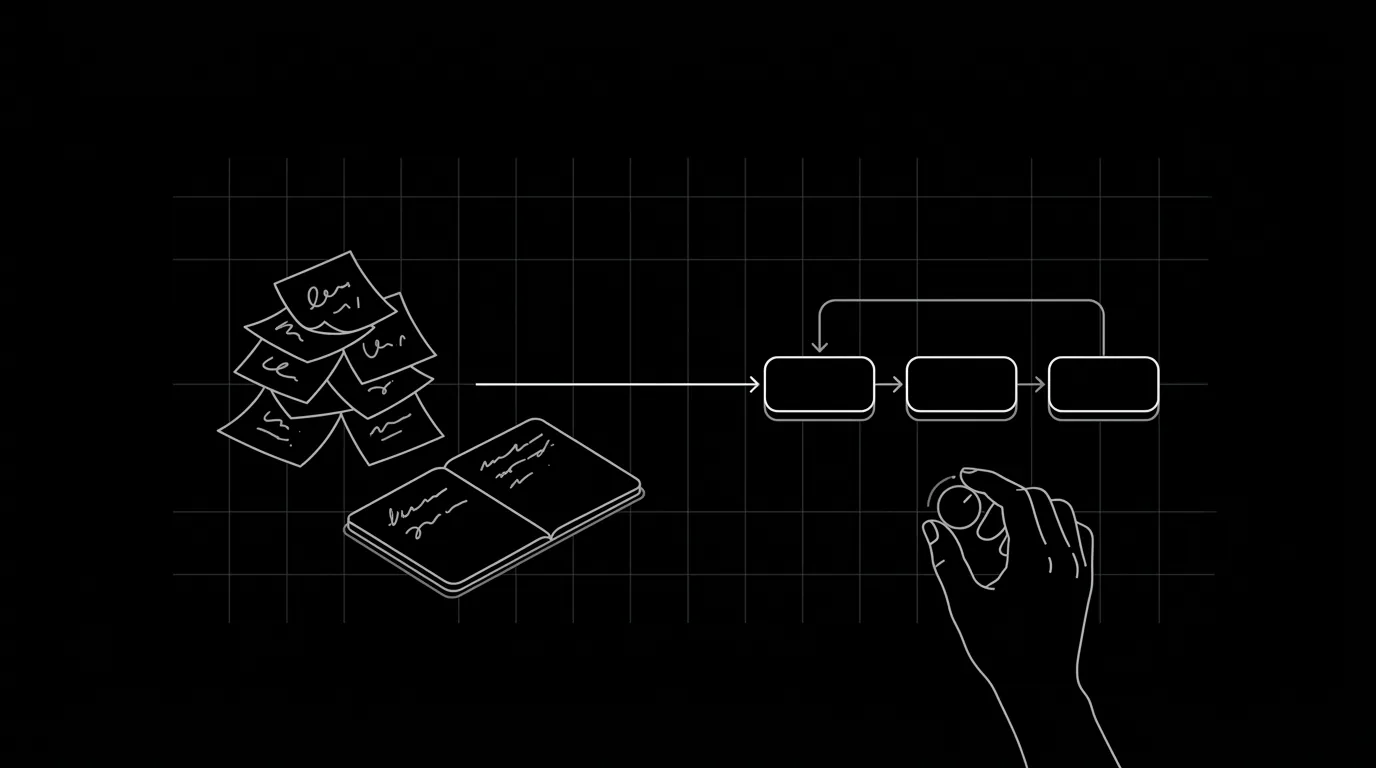
The problem with automating too early
In principle, automation needs a clear flow on hand: what comes in, what happens next, who decides. In reality, that is rare in a new company. You are focused on winning customers and making a profit, and writing down processes is not the priority. That is normal.
- An unclear flow, automated, becomes confusion that runs faster.
- Tools get bought before anyone knows which tasks actually repeat.
- What gets built is hard to change, and nobody looks after it once the person who set it up moves on.
What automation is really for
Automation is not about making everything automatic. It is about two things: giving the people who make decisions accurate, relevant information at the right time, and cutting tasks that repeat for no good reason. Automation is there to support human work, not to make people work for the machine.
Not sure what to automate?
Most companies we talk to are not sure what is worth automating. These are the places where it usually pays off first:
- Enquiries from many channels. WhatsApp, email, website forms, and booking platforms collected into one list, with nothing lost and an owner for each.
- Confirmations and reminders. Booking confirmations, payment reminders, and follow-ups sent on time without someone remembering.
- Invoices and receipts. Details moved into accounting instead of being typed again.
- Weekly numbers. A short report that builds itself from data you already have, instead of a spreadsheet assembled every Monday.
- Staff joining and leaving. Accounts, access, and devices set up and closed with the same checklist every time.
- Approvals. Purchase or leave requests that go to the right person and leave a record.
Does your existing app need automating, or not?
Often the answer is already inside the app you pay for. Before building anything, it is worth checking.
| Sign | Probably worth automating | Probably not, or not yet |
|---|---|---|
| How often | Every day or every week | A few times a year |
| Steps | The same each time | Different each time, needs judgment |
| Data | Typed into two or more places, copied between apps | Lives in one place already |
| Cost of mistakes | Things get forgotten, late, or wrong | Small and easy to fix |
| Your current app | Has no built-in feature for it | Has a feature nobody switched on |
How we help
- Diagnose. We look at how work actually happens today: where data is typed twice, where information arrives late, which apps you already have.
- Pick what is worth it. A short list of what to automate, what to leave alone, and what your current apps can already do.
- Start with one flow, connected to the tools you already use.
- Keep it alive. Automation needs integration and consistency, and it has to be maintained. We review and adjust as the business changes.
No automation in place yet? That is the easiest place to start. We assess, and tell you where to begin.
Our approach
Iterative and flexible. We start small, learn from how your team actually works, and adjust. The automation fits the people, not the other way around: automation for human work, not human work for the machine.
Questions
We are new and our processes keep changing. Should we automate now?
Automate the parts that are already stable, such as collecting enquiries in one place or sending reminders. Leave the rest until it settles.
Which tools do you use?
No preferred tool. We start from what you already use, including features in your current apps, before adding anything new.
How is this different from AI?
Automation follows fixed rules. AI helps where the input varies, like messages and documents. They often work together; see AI consulting in Bali.
Who looks after it?
Someone in your team owns each flow, with simple documentation. We can support and review it over time.
Which task repeats the most in your week?
Tell us →